
Understanding roof pitch in Ireland
Roof pitch is the angle of the roof surface, expressed either as a ratio (rise over run) or in degrees. Most Irish houses built from the 1930s onwards have pitches between 30 and 45 degrees, with older Georgian and Victorian terraces often steeper. Steep pitches shed water faster, which matters enormously in a climate where heavy, wind-driven rain arrives from the south-west for much of the year.
Shallow pitch roofs below 22 degrees require special low-pitch tiles or slates designed to handle slower water runoff. Standard concrete interlocking tiles and most natural slates are only suitable for pitches of 22.5 degrees or more. If you are replacing a covering on a shallow-pitch roof, your roofer must specify materials appropriate for that pitch.
Under Irish planning regulations, replacing a roof covering at the same pitch as the existing roof is generally exempt development: no planning permission is required. Altering the pitch is a different matter and would typically require planning permission.
Roofing materials for pitched roofs
Natural slate
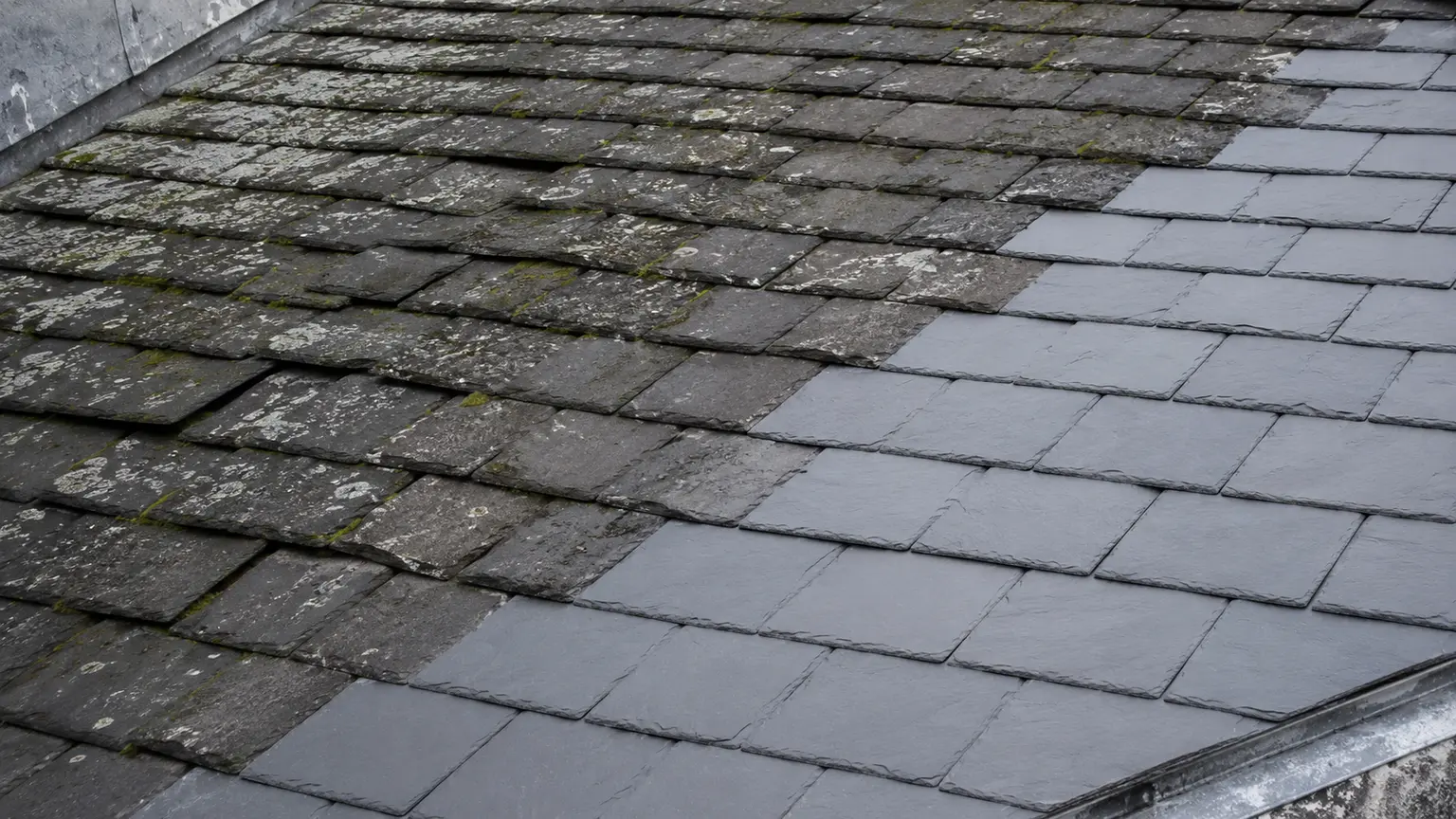
Natural slate is the most traditional roofing material in Ireland and has been used for centuries. Irish Killaloe slate from County Clare was the standard on Georgian and Victorian buildings throughout the country. Today, Spanish and Welsh slate are also widely used, all quarried from similar geological formations to Irish stone.
The lifespan of natural slate is 80-150 years. Many Victorian roofs across Dublin, Cork and Limerick are still covered in their original slates, now over 150 years old. The higher upfront cost compared to concrete tile is offset by a much longer replacement cycle, and natural slate can be salvaged and reused, giving it strong sustainability credentials.
Concrete interlocking tiles
Concrete interlocking tiles became the standard roofing material on Irish housing estates built from the 1960s through to the 1990s. They are heavier than slate, which means the roof structure must be designed to carry the load, but they are faster to lay and significantly cheaper than natural slate.
Lifespan is 40-60 years with good maintenance. Concrete tiles come in a wide range of profiles including flat, double roman and pantile. Many 1970s and 1980s estates across counties Dublin, Cork, Galway and Limerick are now reaching the end of their original tile lifespan and coming up for re-roofing.
Clay tiles
Traditional terracotta clay tiles are less common in modern Irish construction but remain the appropriate choice for restoring period properties where the original clay tile has failed. They have excellent frost resistance and a lifespan of 60-100 years. The mellow terracotta colour weathers beautifully over time.
Clay tiles are more commonly specified for conservation area work in towns such as Kilkenny, Wexford and parts of south Dublin where period streetscapes are protected. Your local authority conservation officer can advise on what is appropriate for a listed or protected structure.
Roof structure: battens, felt and insulation
Below the visible tile or slate covering, a pitched roof consists of several layers. Sarking felt (underlay) sits directly on the rafters: breathable membranes are now standard on new roofs and allow moisture vapour to escape from the roof space while keeping liquid water out. Older roofs used traditional bitumen felt, which is less breathable and can trap moisture.
Battens are horizontal timber strips fixed to the rafters over the felt, to which the tiles or slates are nailed. They must be pressure-treated softwood, sized correctly for the tile or slate gauge (the spacing between each row). Incorrect batten spacing is a common cause of tile slippage and water ingress.
Insulation in a pitched roof takes two forms: cold roof (insulation at ceiling level, roof space unheated) and warm roof (insulation between and over the rafters, roof space habitable). Building Regulations Part L now require higher insulation values in new and substantially replaced roofs. When re-roofing, it is worth considering whether the attic insulation can be improved at the same time.
Ridge tiles, valleys and hips
Ridge tiles
The ridge is the apex of the roof where two slopes meet. Ridge tiles cover this junction and are either mortar-bedded (the traditional method) or mechanically fixed using a dry-fix system. Mortar-bedded ridges are common on older Irish homes: the mortar cracks over time due to thermal movement, allowing water ingress and ultimately causing ridge tiles to loosen or fall.
Dry-fix ridge systems are now the preferred approach. The tiles are mechanically secured and foam-sealed without mortar, eliminating the cracking problem. Re-ridging a typical semi-detached costs EUR 800-1,800 depending on ridge length and whether dry-fix or mortar is used.
Valleys
Valleys form where two roof slopes meet and channel large volumes of water down to the gutters. They are lined with either open lead (a visible strip of lead flashing along the valley) or a close-cut valley where slates or tiles are cut to meet neatly. Lead at valleys should be at least Code 4 (1.8mm) in Ireland to withstand the rainfall volumes experienced in wet winters.
Valley flashings are a common source of leaks when they fail. Lead hardens and cracks over time, or the lead can be poorly dressed against the tile. If you have a leak in a valley, the flashing is the first place to check.
Hip roofs
A hip roof has sloping surfaces on all four sides rather than two, requiring hip rafters and jack rafters at the corners. Hip tiles or lead soakers are used at the intersections. Hip roofs are popular on 1930s semi-detached houses and post-war bungalows across Ireland and generally perform very well in high winds, as there are no exposed gable ends.
Ventilation for pitched roofs
Ventilation is a critical and often overlooked aspect of pitched roof performance. A cold roof (insulation at ceiling level) must be ventilated to prevent condensation forming on the cold underside of the felt and on structural timbers. Condensation in an unventilated roof space leads to timber rot, which can be extremely expensive to repair.
Irish Building Regulations require a minimum of 1:300 cross-ventilation in cold roof spaces, meaning the free ventilation area must be at least 1/300th of the insulated ceiling area. In practice, this is achieved through eaves ventilation (a continuous slot in the soffit or individual eaves vent tiles at the bottom of each rafter bay) combined with ridge ventilation at the apex.
Ridge ventilation is provided either through dry-fix ridge systems that incorporate a ventilation gap, or through purpose-made ventilated ridge tiles. Tile vents can also be retrofitted into an existing roof: they replace individual tiles and provide ventilation at mid-span. If your attic is hot and humid in summer or shows signs of damp timbers, inadequate ventilation is the most likely cause.