
Get at least three quotes
Never accept a single quote for roofing work. Prices for the same job vary significantly between contractors, and without comparison you have no way of knowing whether you are paying a fair price. Three written, itemised quotes is the minimum: they give you a meaningful range, allow you to identify outliers in either direction, and create healthy competitive pressure between contractors.
A quote should specify materials by brand and specification (not just "slate" but "natural Spanish slate, S1 grade, 500mm x 250mm"), the exact scope of work, the start date and expected duration, the payment schedule, and whether VAT is included. Compare quotes on the same basis: a quote for Spanish slate and a quote for concrete interlocking tile are not comparable even if they cover the same house. If quotes vary by more than 30-40%, ask the outlier to explain what is included in their price. A very low quote may simply exclude scaffold, VAT or critical materials.
Check reviews and references
Google reviews are the most reliable public signal for local roofers in Ireland. Look for volume (ten or more genuine reviews), recency (within the last 18 months), and specificity: reviews that describe a particular job, mention the area of the country, or reference the roofer by name are more credible than generic one-liners. A contractor with 40 detailed five-star reviews over several years is a more reliable signal than one with three reviews from the same week.
Ask the roofer for two or three recent customer references you can contact directly. A phone call to a previous customer takes five minutes and can tell you more than any online review: how the job went, whether the site was left clean, whether the price held to the quoted figure, and whether the roofer was easy to communicate with during the work. A professional roofer with a solid track record in your county will be happy to provide references. Reluctance to do so is worth noting.
Public liability insurance
Any contractor working on your property must carry public liability insurance. This covers you if a worker is injured on your property or if the contractor causes accidental damage to your home or a neighbouring property. The minimum recommended level for roofing work is EUR 2 million. Ask to see the insurance certificate before work begins: it should be a current document (not expired), show the contractor's full name or company name, and specify the level of cover.
If the contractor employs other people, they must also carry employers liability insurance. Working on a roof without appropriate insurance is not just a risk to the contractor: it is a risk to you as the property owner. If an uninsured worker is injured on your roof, you may be exposed to liability. Checking insurance before work starts costs nothing and takes one minute.
Written quotes and contracts
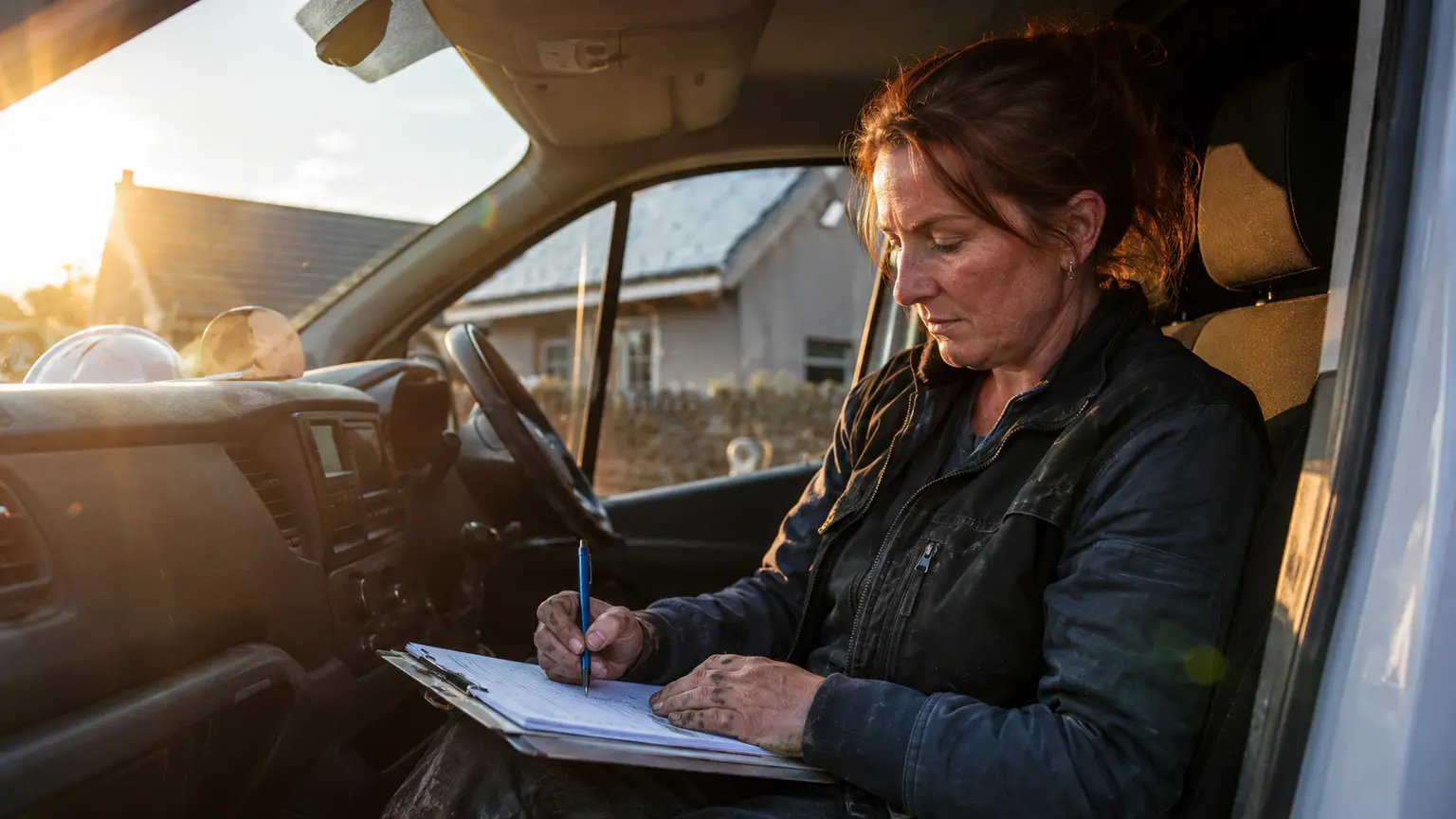
A verbal quote has no legal standing. Get everything in writing before any work begins and before any deposit is paid. A proper written quote should include: the contractor's full name, company name (if applicable), trading address, and VAT number if registered; the exact scope of work; materials specification; the total price (inclusive or exclusive of VAT stated clearly); the start date and expected completion; the payment schedule; and the workmanship guarantee offered.
Do not sign anything under pressure. Any contractor who says they need an answer today, who claims the price will go up tomorrow, or who says the materials are only available if you book now is using sales pressure tactics that are inconsistent with professional practice. A genuine professional has no need to pressurise a customer. If a contractor arrives at your door offering to start work the same day without a site visit, be very cautious: a proper quote for roofing work requires inspecting the roof from above, not just from the ground.
Payment terms
Never pay the full cost of roofing work upfront. A deposit of 10-30% before work begins is reasonable for a small to medium job and allows the contractor to order materials. Staged payments during the job are normal for larger projects: for example, a payment when the scaffold goes up, a payment when stripping is complete, and the final balance on completion. The final payment should not be released until you have inspected the completed work and are satisfied.
Pay by bank transfer or card wherever possible. These payment methods create a paper trail that is invaluable if any dispute arises later. Cash payments with no receipt have no paper trail, no record for tax purposes, and no basis for a warranty claim if something goes wrong. Withholding the final payment until you are genuinely satisfied with the completed work is your right as a customer: a professional roofer will expect this and will not object to a reasonable inspection period.
Red flags to avoid
The following are reliable warning signs that a contractor may not be legitimate or may not deliver professional work: no fixed business address (only a mobile number and no verifiable location); no VAT number or refusal to provide invoices for work above EUR 10,000 (VAT registration is legally required at this turnover level in construction); cold calling or door-knocking to offer work immediately; pressure to sign a contract or pay a deposit on the same day; no public liability insurance certificate available or available only after persistent asking; an unusually low quote with no written breakdown of what is included.
Rogue traders cause significant financial harm to Irish homeowners every year, particularly following storm events when demand for roofing services spikes and legitimate contractors have full order books. Taking thirty minutes to check a roofer's credentials, verify their insurance, and read their online reviews before committing can save you thousands of euros and months of stress.
CIRI and professional registration
CIRI (Construction Industry Register Ireland) is the voluntary register for competent building contractors, operated by the Construction Industry Federation. CIRI-registered contractors have agreed to a code of conduct, carry appropriate insurance, and meet minimum competency standards for their trade. You can search the register at ciri.ie to verify whether a contractor is listed.
VAT registration is another useful indicator of an established business. Any contractor with turnover above EUR 40,000 in construction services must be VAT registered under Revenue rules. A busy, established roofer with a full order book will almost certainly be VAT registered. If they claim to be very busy but are not VAT registered and offer to do the job off the books, this inconsistency is worth querying directly.
CIRI membership does not guarantee quality, and excellent roofers operate without it: it is one indicator among several, not a definitive test. Combining it with strong Google reviews, direct references, a written contract and insurance verification gives you a rounded picture of a contractor's professionalism before any money changes hands.